


Table of Contents
I had a relatively early life lesson about distrusting “free money”.
In my teens, I was on an academic scholarship for a couple of years, before leaving in what ended up dragging out to a horrible few months, when I started to realise what the school was truly about. Now I am extremely skeptical of institutions that offer scholarships or grants, and really try to scrutinise how they earn their money — whether it is universities, investors or anything else — before I might even think of applying.
This is also perfectly summed up in a single paragraph, in a recent article on RT on education in Kota, a small-city coaching hub in India:
“Education in Kota is now a highly commercialized game played by big business,” [Naveen Mittal, secretary of the Kota Hostel Association] told RT. “These coaching institutes select ‘poster boys’ at the time of admission and pay special attention to them. Not much attention is paid to other students, who are used only for milking high fees. This has caused great competition, a sense of inferiority, and depression among students who did not perform well. If this problem is solved, I do not think students will think about taking extreme steps.”
Source: RT - Coached to death: How stiff competition to get into universities in the world’s most populous country becomes a race for life
Also summed up simply, in this screenshot from the game Lumino City:
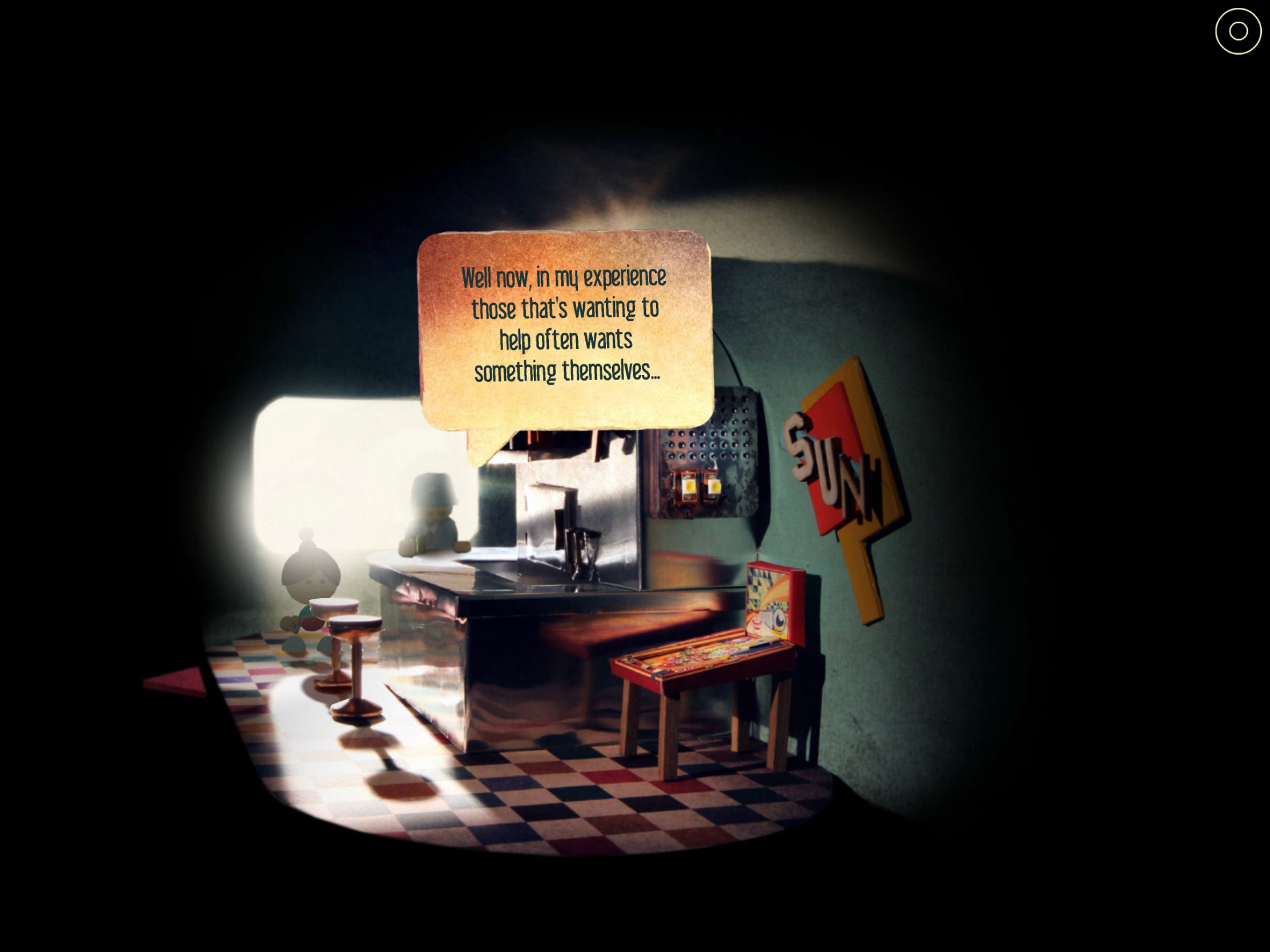
Companies have it in their interests to share good stories about people getting scholarships and grants. And if it got them in a place that helps them be more successful, people who have been on scholarships and grants also have interest in sharing good stories.
Rarely do you hear a negative story, so here is one truth among many truths, from a person who has been through it.
The Promise of a Deserved Better Future ® for Merit & Hard Work
When I was 14 years old, I got selected for a full academic scholarship at a private school, due to start the following year.
From everything I had heard about scholarships — from my parents, from other adults, from the tutoring place that I went to — this was great news.
Being a daughter of refugees — who’d spent days and weeks out on endless ocean without food or water to escape colonial and imperial wars on their home country before being taken in by other neighbouring countries, and then a wealthier Western country, Australia — it seemed like a true blessing to have the chance to make that generational jump from the lower classes to the middle or upper class.
My parents had worked in local small business or at home for local factories making clothes. I had attended local Catholic schools and a local government school during my primary age and early high school years.
Like the parents of some of my school friends and cousins in the working class north-western suburbs of Melbourne, they’d paid for me to be tutored so I could practise specifically for the scholarship tests of private schools and the entrance exams for four noted government schools in the state.
I had applied for a scholarship at this private school when I was in year 6, but had been rejected. I had scored quite highly relative to other applicants in maths and reading comprehension, but not as highly on my writing. In my application essay this time ‘round in year 8, I had written about the need to provide the key and means for all students to have an open door for their future and education, regardless of personal and economic disadvantage.
One of my friends who had also applied at the time in year 6, and had been rejected too, had had an older brother previously accepted for a full academic scholarship. Her mother physically had beat her for not getting accepted, and I remember feeling a lot of empathy & sympathy for her.
When I first had a meeting with the private school where they offered the scholarship to me, they showed me the fees that would be waived by the scholarship and the other fees that we would have to pay. I saw the total annual kindergarten fees starting from around $5000 that time in 2013. Year 9 was already about $17,000 in total and each subsequent year they increased until Year 12 was about the price of a car at around $23,000.
The academic portion of the fee, comprising roughly three-quarters of the total annual fee, would be “fully covered” by the scholarship. We would just have to pay the development fee, which was put towards the buildings on new campuses and school-grounds, and the board fee, which I had no understanding of at the time but the school apparently has a board like a commercial company does. (Suspicious! It should have been the first red flag!) The development fee constituted a little more than half of the remaining fee, and the board fee the rest. They told us that the fees would likely increase each year — “they never go down!” — so I have no idea how much it is now.
At the time, I regarded it as greatly generous of the private school, that they grant me this scholarship. In total over four years, they’d give me around $80,000. It was like winning an episode on the Millionaire’s Hot Seat or the lottery tickets that my mum would always (and still does) buy. How generous it was for them to help non-rich people, as I had written about in my application essay.
(Later my dad was to hiss to me that he had to really set aside money each week to be able to afford our portion of the fee, when he was trying to guilt-trip me about leaving school, but that’s for later on.)
The only catch is that once I accept the scholarship, I can’t attend another school or else we would have to pay back the full amount. That seemed like a non-existent thing to worry about. Why would I want to go to another school when I got accepted into such a “good one”?
Life while being financially supported for what you do (or is it what they want you to do?)
Then I attended the school.
Differences in resources and socio-economic status
In the newer campuses, this private school had award-winning architecture with bold, sweeping shapes, and colourful brick patterns. Rooms were inset with gorgeously vibrant doors in every hue — from striking vermillion, magenta and lime, to pastel lilac, aqua and teal — with soft fabric pinboards in the same colour to match.
The buildings and even the hallways were always mildly warm in the winter. This was really not a thing in the previous government school I attended. We had portable buildings where sometimes the heating wouldn’t work, and in winter we’d joke to each other about how it was colder inside the building than outside. And in year 5 & 6, I remember our teacher was real old-school and he’d refuse to turn on the heater during winter, to make us toughen up and brave the cold.
At the private school, there also were less students deeply troubled by serious family matters and simultaneously without support. So no one disrupted classes by fighting with the teacher and leaving in the middle, which would often happen in previous schools I attended. I don’t think I ever heard of anyone getting suspended or expelled in the private school, which would happen to about 2-3 students each year in my year level at previous schools.
The teachers in the private school were also always encouraging us to make time to see them to ask questions outside of class, whether before or after school, or during lunch breaks. This was also almost not a thing in the previous government school I attended. There were also teachers at the private school who would have their children attend as students, and this made me grasp the difference in pay.
As if this wasn’t bad enough, Inga Ting et al on the ABC have some great reporting on how private schools get more government funding than public schools and the vast differences in income and infrastructure across many more private schools and public schools:
From orchestra pits and on-site baristas to ripped carpets and leaking roofs, this is the “infrastructure arms race” between Australia’s schools.
These 8,500 schools are ranked from highest to lowest on the income ladder, according to their average yearly income between 2013 and 2017.
Awards & congratulations & congratulations & congratulations
Plenary
By the time I was starting the final year of high school, I was really desperate to leave the school. I suppose this grew gradually rather than all at once.
In year 10, I’d won an award named after a former student who had, sadly, passed away in a vehicle accident while in his school years. This was a $1000 award from his surviving family that went to subtracting from my school fees again.
His two favourite subjects had been Latin and science. My Latin teacher had nominated me and another student for the language part of the award, but we ended up both receiving awards in areas different to her nomination. (I got the science part of the award — was studying 4 science electives.)
This award was bestowed upon me in a larger yearly school ceremony held at the Melbourne Convention and Exhibition Center (MCEC), in the Plenary. The MCEC is used for big conventions like PAX and so on. So this pompousness was already enough to sicken my stomach. I was so anxious to minimise my time on the stage that I barely noticed that I should shake the principal’s hand, and my family complained that I hardly glanced at the crowd as I hurriedly collected the envelope and crossed the stage, since they couldn’t get a good photo.
At that event at the MCEC, I met my friend from year 6 who I previously mentioned had also applied for a scholarship but had been rejected, though she had gotten into one of the selective entrance high schools. She and her family were attending this event since her brother was receiving an award for having achieved the highest university entrance score in the previous year. I saw her mother and father.
I wished that I could give my scholarship to her, that she could take my place.
By the way
In the middle of year 11, the principal of the year 11s and 12s listed our names on the daily bulletin during snack break and we were to meet in one of the lecture theatres.
She said we weren’t in trouble — she just wanted to congratulate us, for getting A’s in at least five of our subjects. What was an A? I didn’t know, but it turned out that it’s getting 90% or higher. I was doing 7 subjects at that time in year 11.
As she wrapped up, she said, “by the way, last year there were 27 students who got an ATAR (Australian Tertiary Admission Ranking) of above 99. There are 27 of you here, so who knows?”
To which people ooh’d.
This was troubling to me. So the ATAR is the ranking that most of the major universities use as their primary cut-off for selection of prospective students into courses. So there are about 250 students in a year level, and this school has one tenth of their students getting a score in the top percentile.
Not only that, but the highest ATAR last year that a student at my previous government school got was around 97.
This was extremely suspicious to me. I really didn’t want to study just for the sake of getting a high score. I was already coding by that time and I loved using what I learnt in maths and science classes in my coding projects.
I spoke at length with a few teachers over the next year or so, and found many of my sentiments echoed. One teacher said to me that the average ATAR at the school each year was about 80. “Get it down to 50 like the rest of the state!” he said. And he said that he also didn’t like the aspect of the school being a “sausage factory”, like “in goes Tracey and out comes an ATAR of [X]”.
Another also concurred, when I expressed how horrible it was to learn for the sake of exams, saying “Yeah, what a sick way to learn.” He said to me at another time that the principal was expecting me to be the dux of the girls, i.e. have the highest ATAR score out of all the girls for that year. The most important thing that he said to me was, “Are you happy here?” I wasn’t.
I dropped Latin not long after that, not wishing to make the most of the high score that it can provide, and then also dropped Chemistry at the end of that year.
The school would also have internal reports shared to students and parents, saying that the top two universities in the city would be the top destinations for students after leaving school. And there were generations of parents who had attended the school as children. It was a cycle of wealth.
The Educational Opportunity in Australia reports in 2015 and 2020 both reflect what I and the teachers there intuited and know.
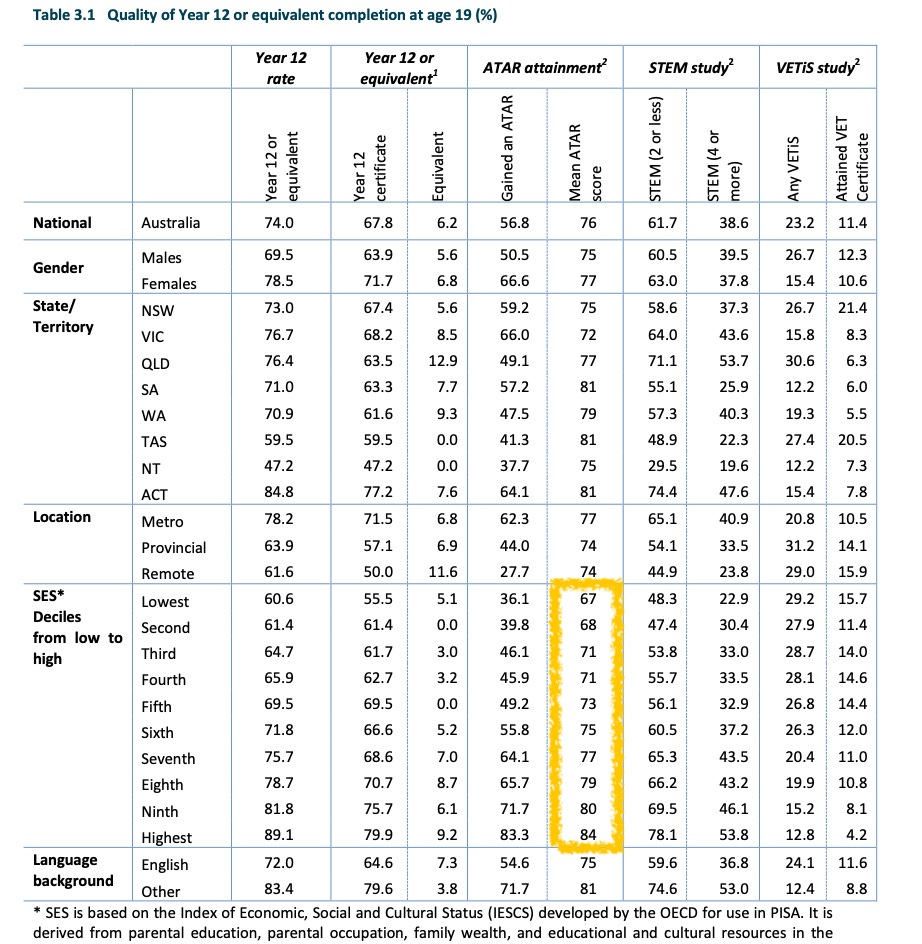
The 2015 report on page 44 shows the average ATAR score for each socio-economic decile (split into 10):
Not only do high SES [socio-economic status] students gain an ATAR at more than double the rate of the most disadvantaged students, they achieve a higher ATAR score on average. The average scores range from 67 for those in the lowest decile of SES to 84 for those in the highest decile. So for young people from low SES backgrounds there is a double disadvantage: not only do they far less often receive an ATAR, something they need to gain entry to university, when they do they more often achieve a low score, meaning that they are more poorly placed in the race for places in higher demand courses and access to associated professions. The probabilities of participating in university and pursuing more prestigious professions for disadvantaged students are comparatively very low […]
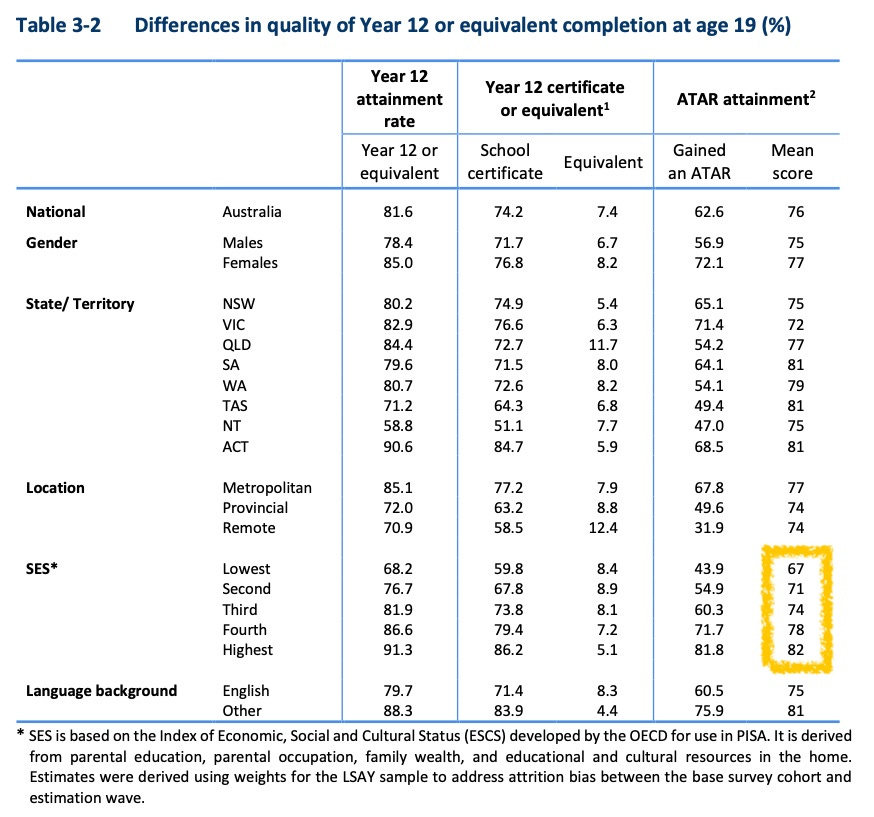
The 2020 report on page 42 splits socio-economic status into quintiles (split into 5) but tells a similar story:
Aside from that, Australia has the most segregated schooling in the OECD and among the worst in the world. i.e. The rich stay with the rich and the poor stay with the poor.
Getting a bit annoyed now
Another award that I received, this time at the end of year 11, was an award where you get a braided band of colours around the sleeve of your school blazer (fancy thick jacket). I was actually pretty mad at the school by this point.
They awarded me for something to the extent of my passion for IT and the things I’d done to that end — I got accepted into the National Computer Science School (NCSS) Summer School held in the upcoming January, and I’d attended a conference held by a company where I previously did work experience, and more minor things like that.
But what actually made me disgusted — it probably doesn’t seem that big of a deal in the bigger picture, though it mattered to me a lot at the time. In the previous year, during year 10, there was an iOS coding club that was going to be held by a former alumnus of the school who had worked at Apple. The thing was, it was only going to be held for year 9 students. I kept asking for them to allow me since it hadn’t been open to the girls’ campus before, but they were strict. I had gotten really upset and was crying in the car on the way to school.
(I had really wanted to be able to do my main hobby — coding — in classes, rather than have to scour virtually for all my knowledge, and be able to meet other interested people. And my mum usually acts like crying is too much of a fuss over a small thing, rather than an expression of emotion, but she just assuaged me by saying they (parents) could pay for me, when I said if I could take an online course. So that was what ended up happening, instead of taking that club. And years later after learning another programming language, I was able to work as an iOS software engineer anyway.)
But anyway, it disgusted me that the school was awarding me for something that I had to go and do on my own anyway after they didn’t let me study it at school.
An aside about awards
It became very apparent to me that the piling on of awards is to make you confident, special.
This is actually THE key difference between private school and non-private school kids. It is that you are used to receiving special treatment.
This is how you make demands upon services — this IS one of the unfortunate takeaways from private school that I know how to use when services aren’t delivering — yes, when later on I encountered youth homelessness services and youth mental health services during psychosis. You have to ask yourself, what would I be getting if I was a proper young person?
It is as if, you have to learn to complain like a middle class person. Us working class people, immigrants, we don’t complain like that. Because who would listen to us?
This is THE difference between the mindset of the middle-upper classes and everyone else — it is knowing how to act as if you should receive special treatment when things don’t go your way.
This is exactly what journalist Stan Grant was talking about when the “#MeToo” movement hit the class of white professional women in Australia.
ABC journalist Stan Grant has used an appearance on Q+A to call out Australia for only taking notice of sexual assaults when they happen to "middle class" white women.
[…]
"As necessary and as urgent and as righteous as these claims are, and this movement is, there have been so many women's voices who have not been listened to for a long time," Grant said.
"And ... when it becomes a white middle-class issue, when it is in private schools, when it is in Parliament House, when it is in the press gallery, we take notice.
"But when Aboriginal women who have been suffering domestic violence at rates 40 times higher than the rest of the population, 10 times more likely to die as a result of that violence, when I have seen Aboriginal women marching and protesting and calling for support for generations, I did not see the same women outside Parliament House.
"When poor women, when migrant women, when refugee women have suffered these things, I did not see the same media attention.
"Poor women do not end up on television programs, they are not on Q+A, there are a lot of voices that are not listened to here and while this is a movement and a moment we need to reflect on our own blindness and biases."
I just heard
From teachers
Aside from the difference in resources and the awards to condition your mindset, there were the things that I heard teachers say in the hallways and classrooms that fully captured the mindset in single sentences.
The principal of the year 11s and 12s happened to teach one of my classes, and I heard her a couple of times. One time, she finished, “the other schools don’t have enough resources, and we knock them out of the park!”
Another time, she described how students kept asking why the SATs (some kind of periodic assessment) were set so hard by the school. She said that the SATs were set hard so that the school’s scores would be scaled up at the end of the year after the other results had come in, and again that they would knock the other schools out of the park. So I thought: they are gaming the system.
Another time in a language class, the teacher would riff various takes on the selective entry state government schools. He scoffed, about the previous year’s highest attainers: “Not one of them got an ATAR of 99.95!” (the highest possible ranking, in the 0.05th percentile — usually about 30 students or so in the state each year).
Other times, he would insult subjects taught in other schools or this one — cooking classes and business classes — “what do you learn in cooking class? In business class?”
I was very disgusted at those. I loved cooking and textile classes in my early high school years, and had friends in business studies.
Then in the final year of high school, I had a maths teacher say “you just need to plug the numbers into the formula — you don’t need to think”.
They would also spoon-feed us in English by telling us all, in detail, the themes and notable quotes of the novels and plays and movies that we studied.
It was interesting because of two things in the year that I first started at the school: the school was getting really big on being a Thinking School, and I had a teacher say that private school students would often perform worse and drop out of more classes in university than public school students. It is because they spoon-feed you and teach you to the test and game the system.
From students
I got to spend a bit of time with a high-performing student who was really paraded on pedestals around the school and beyond. He and the other boys had compared scores for a mid-year physics exam in year 11, and they had determined that he had the highest score of 90%. He asked what I got, and I said I disliked comparing scores and things. I did show him I had scored 91%.
Across the time that I was in contact with him, he joked about lower-level maths students not knowing how to use the calculator; said that since I go to this school, I shouldn’t be thinking about applying for tertiary education without ATAR requirements; implied that art was for people of lower IQ, and so on. He ignored me after I kept asking him to stop.
Besides that kind of thing, I had a fellow friend say that other people (students alike) kept looking down on them for not taking any maths or science subjects.
Can I — no.
And last but not least, I couldn’t really do the subjects that I wanted.
In year 12, I wanted to stop doing English (focus on literary analysis) and do English Language (focus on linguistics) instead, which they didn’t offer at the school. But they wouldn’t let me — even if I were to take English Language via distance education, I would still have to take English.
And I wanted to drop physics and do art, but I couldn’t. And more.
So yeah. That was life under the scholarship.
SO BACK TO THE ORIGINAL TOPIC: actually, can i leave
Ok so you got accepted into a grant or scholarship with the promise of a better future and recognition of all the hard work you’ve been doing.
You spend some time there, you get some work done. Then you think that the place is probably corrupt as heck. All the people have no idea, except for one or two people whose company you’ve become desperate for, in the misery that life in the institution has become.
And it turns out that you can’t actually do the thing that you want to do.
Leaving is an absolute pain
This dragged out for months.
I wanted to leave because I want to learn for the love of learning, and not for scores or tests or praise.
I knew that I just couldn’t get what I needed from staying at the school. For example, I knew that if I actually want to write accurate stories as an author, I couldn’t get that from staying in school and continuing to university, throughout both of which you remain ignorant of and isolated from the world. I was also tired of having to treat everything as absolute fact in physics tests — from year to year, one model was disproven but we have to treat it as absolute truth for exams.
I was prepared to face the scorn and prejudice that people have for school-leavers, even if it would cost me my sanity, I thought, because my parents don’t accept my decision and will hound me for it.
But they wouldn’t let me leave.
I skipped classes. I wrote nothing for questions on my tests. I failed to buy the books needed for class.
I was in existential crisis. I was drawn on by an Unorthodox Beckoning — the name of this publication. I wanted to be outside when it was sunny. I wanted to learn from life.
I didn’t need a institution, fancy or not, to teach me how to learn. This is encapsulated in the philosophy of unschooling, by John Holt, who is considered the father of homeschooling in the United States — he was a former teacher who decided that school could not be reformed for learning. He wrote the books How Children Fail and How Children Learn, among others.
I sought the company of teachers who understood the turmoil and the passion. One teacher said I inspired him.
Eventually teachers chased me down, admonished me, escalated the situation. One told me how it was sad to see a student doing so well suddenly go like this. One made me retake a test that I had left blank, made me stay when I tried to escape, and didn’t let me go even when I started crying.
My parents treated me horribly, honestly. My dad threatened to break my laptop when I said that what I did outside of school mattered more to me than in school. He insulted me other times, one time insulting my pay when I got an internship, and another time saying, “I work all day. All you have to do is eat and study, and you can’t even do that.” My mum guilt-tripped me about all those years she spent driving me to school. (My sister and I were not to use buses because of safety and weather). She screamed and yelled at me on the trip to school, on the very last day I was at school. They both held it over my head that the school would make us repay the scholarship, which they didn’t have money for. I didn’t think the school would actually do it at first, but when my parents kept bringing it up, I felt trapped and guilty. I felt like not living anymore.
A teacher explained to me that the school valued my parents’ decision above mine, in terms of wanting to leave, because they pay for the education (again, like the parents are the customers).
Eventually it finally got escalated to me leaving school, which I had wanted.
Nearing the middle of the year, I spoke to the vice-principal of the entire school, whom I had met during my very first meeting with the school where they offered me a scholarship. I said that I lost interest in things that I used to like doing. She said that she can’t imagine that.
They needed proof from a doctor or medical professional saying that I’m unfit to continue schooling. A doctor asked me questions and said that he’d probably have to basically exaggerate to let me leave.
The final thing was that they needed permission from the board to let me leave. This gave me a lot of question marks! (Another hint that you are playing some role for a company.)
Anyway, one of the teachers who I was talking to regularly told me that the vice principal said they’d never make me pay back the scholarship. The vice principal also told me herself that whether I wanted to continue my education again at this school or another school, I was welcome to.
Aftermath
Surprisingly some of it pretty much went as I first expected.
I tried to learn things at home and do my own projects, which I found deep enjoyment in, and from which I learnt many things. But with my parents, it was kind of an impossible environment. I was scared of them. And they kept criticising me.
Eventually after 4.5 years of that, I left home and went through youth homelessness services. I worked as a content creator making videos for a company, and then worked as a software engineer for the same company. Recently I began experiencing series of psychosis episodes. Maybe it’s both after 6 years of accumulated stress and risk due to family history.
But anyway, I did savour what I grasped, what I dearly wanted — the ability to write original things.
Preliminary Conclusions
General Conclusion
The main conclusion which I want to share with this piece is that you are a poster-child for an institution, when you sign up to take their scholarship.
This particular conclusion I was able to draw out after talking with a teacher at a different institution. He told me about how another teacher teaching a senior level would always try and pick out the best-performing students in the junior level. And when these students still did very well after finishing the course, this teacher would take all the credit. That is, look how good my students did — that must mean I’m a great teacher.
This is how these institutions function as a whole. You are the product. Marketed to high-end buyers. To get them to spend $ on the institution.
Because most of the high-performing students that I had run into at the school were also scholarship students. From, say, seven top-performing academic students, about five of them would be students stolen from other places, rather than students who had been with the school since kindergarten or prep.
I saw on an online forum, before I attended the school, posts of people making random bets as to which school would get the highest scores, and they included this school among their top five.
You perform well so the institution looks good as a whole, which makes it look really promising to other customers. Like if you are doing so well, then they will do so well too. Then other customers spend a lot of money on the institution, which enables the institution to afford some resources more. This makes them look more attractive yet again compared to other options.
And then they can offer one or two measly free places to students who will make them look good, so they can get more high-paying customers yet again, etc.
Universities, tertiary education
This is also applicable to universities, and I’ve definitely met people aware of this, both people who grew up here and people who came to study from elsewhere.
After enduring all that, with being a scholarship student at a private school and trying to escape, I absolutely did not want to be a scholarship student at a university, bound by all these rules and having to please the institution.
With universities, high-performing domestic students are used to market the university to paying international students. Universities are publicly touted, by government figures, analysts and media alike, as multi-billion dollar industries.
(It felt much harder to find this awareness for high school, probably because it’s hard to find the right company. Most high school students don’t care to observe, and it’s hard to reach high school teachers, let alone those who are aware.
Well-performing school students who go through with it are likely notoriously self-absorbed or have benefited from their obsequiousness to the system. I’ve seen a supposedly humble cousin’s mother phone the relatives to brag about her daughter getting an ATAR score of 94. And I once attended a panel at a university on the topic “Women in Physics” where a student who’d gained an ATAR of 99.95 say that the score doesn’t matter, but she has obviously benefited from the score.)
Capitalism is the fabric of —
So this is why I don’t want to go through the horror show again. I am bitterly suspicious and extremely reluctant when I see any place offering a “free spot”. A grant is as suspicious as “free money”. I check how they say they earn money and model it in my head.
And now it becomes easier to see it everywhere.
For example, when investors offer “grants”, or “investment”, it’s really them putting money in a box, waiting for some period of time, and then getting more money when they open the box. That money is stolen from workers.
Because investors don’t actually put any work into the product — the workers do, and they get some of their earnings leeched upon.
It’s the same as company owners taking profits from workers for themselves, in supermarket chains, big businesses, anything. This is especially acute in Australia, where in many industries, the top four companies dominate more than 80% of the market, as detailed in this great article on The Monthly:
One standard measure of market concentration judges an industry to be concentrated if the top four players control more than one third of the market. In 2016, we calculated this measure for 481 Australian industries and found that more than half of Australia’s industries are concentrated.
Some sectors are particularly tightly controlled. In department stores, newspapers, banking, health insurance, supermarkets, domestic airlines, internet service providers, baby food and beer, the biggest four firms comprise more than 80% of the market. In fact, it’s hard to come up with examples of Australian industries that are not dominated by a few behemoths.
If you’re in creative industries or software or other, “pitching for grants and funds” — it’s the same thing. It sounds great, on the surface — someone will give you free money to work on a project that you’re passionate about. You’re taught to prepare for this as if it is natural and normal. But it’s not. There are parasites upon the workers.
I think the late anthropologist David Graeber discusses, in his work, at length, about interest, how there are people making money from others’ loans.
Investment is like that, but it comes from assigning a value to a company, like a product.
Superannuation is capitalism for everyone — this is also openly touted, by the way.
The most powerful argument for the Coalition’s [super on housing] policy is that when you buy a house, you’re really making an investment. It’s just that where superannuation funds invest your money in the stock market, this lets you choose to invest some of it in property instead. […]
Superannuation was the logical extension of a philosophy that sees every worker as a shareholder; it made us all part of the investor class. So perhaps we shouldn’t be surprised if we begin to see the world as a series of potential investments, even in markets that should more primarily be about need.
Source: Waleed Aly on the Sydney Morning Herald
You put your money (retirement savings) into a box, and you come back later, and it has magically increased. That money was put into funding projects for other workers and then stealing some of the profits back for you.
Then there is rent and everything. As others such as journalist Caitlin Johnstone have described, the idea of rent consists of you keeping a property nice and tidy and clean, and paying the owner while you do that — on top of the owner being able to sell it for a higher price than which they bought it. The owner put their money into a box (buy an investment property) and also gets more money (rent), before they take the money out of the box (sell the investment property). When people are promoting owning an investment property as a good source of income, it’s a euphemism for that.
Underlying all this is the fact the Western empire is a colony upon the rest of the world, but that’s for another time.

So the bottom line is: I am suspicious of scholarships and grants and I wouldn’t jump to recommend any of it by default. Be sure to research.
For example, that includes for software here, by the way, like Substack — which is free to use. But again, you, the writer, are the product, marketed to other customers — the readers!
Other open source software like Ghost and Discourse are completely free to download and host yourself, and they make money from hosting. I use Ghost for my main personal sites.
There are places like the Recurse Center which is a programming retreat that is free to attend, and they are upfront about their model and how it is free to attend:
How can you afford to make RC free?
RC has a built in recruiting agency. Companies pay to hire RC alumni. This payment never comes out of your salary.
If you want a programming job, either immediately after your batch or many years later, we can help you find one. If you don’t want a job, that’s fine too. There’s no obligation to work with RC to get a job at any point during or after your batch.
It is worth researching, because, whether for software or for institutions:
It is precisely when you need to exit the place, if you find out that things are not how you expect or they’re not working for you, that you need true freedom.
True freedom.
Not the “freedom” that they promised you — the “paying you so you can have the freedom to do and work on what you want” (sound familiar?) — when they gave you the money to do what you they wanted.


Comments